

One of the primary equity-level themes playing out in 2025 is the resurgence of international stocks, both developed and emerging markets fare. In the case of the latter, China is contributing mightily, providing some relief to battle-scarred investors long holding cap-weighted index and exchange traded funds in which Chinese stocks account for massive percentages.
Though the gains have, unsurprisingly, been accompanied by higher volatility than the S&P 500, the iShares MSCI China ETF (MCHI) (green line) and the KraneShares CSI China Internet ETF (KWEB) (blue line) are trouncing the S&P 500 on year-to-date basis.
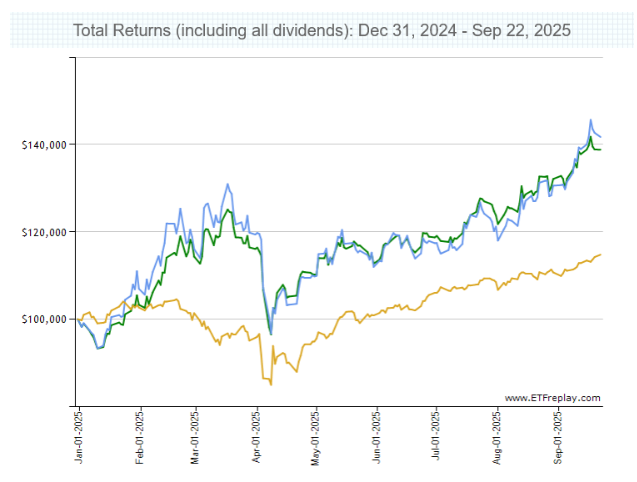
(Image: ETFReplay. com)
Making the rebound by stocks in the world’s second-largest economy all the more noteworthy is that it’s accruing against negative economic sentiment. In fact, deflation concerns are so elevated in China that the situation is drawing comparisons to what Japan experienced – something it took the Land of the Rising Sun more than three decades to snap out of.
“China has a structural problem of overcapacity, which is creating deflation, or falling prices. So far, manufacturers are absorbing the downward pressure on prices, with the producer price index (PPI) sitting in negative territory for nearly three years,” notes Michelle Gibley of Charles Schwab. “The consumer price index (CPI) has bounced around the zero line for over two years, brought down by falling food prices. Core CPI (excluding food and energy) has posted only one month of deflation since the pandemic. ”
KWEB Impressing
The $9. 55 billion KWEB’s 2025 showing is truly something to brag about because over its 12+ years on the market, the fund has evolved into THE ETF proxy on Chinese consumer cyclical equities. It devotes a combined 78% of its weight to that sector and communication services names, many of which clear e-commerce/online retail ties.
Consider this about KWEB: it’s soaring at a time when Chinese consumers are in glum moods as highlighted by the Schwab chart below.
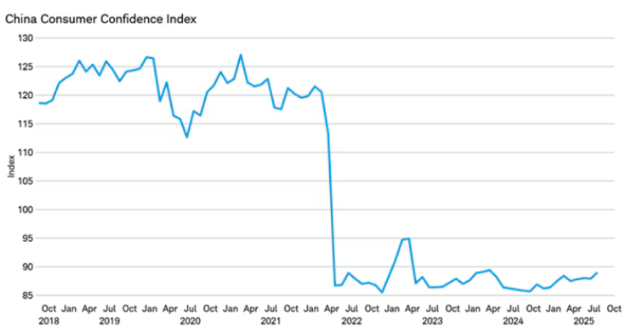
“Domestic demand has been depressed by low consumer confidence, which never regained momentum after the harsh ‘zero-COVID’ lockdowns of 2022,” adds Gibley. “Business confidence has also eroded over recent years due to abrupt policy changes that increased regulations and appeared to be anti-business and anti-profits. ”
There are, however, green shoots. Just look at the rebounds notched by Macau casino stocks this year as gaming revenue there is on pace for its best post-pandemic year and by a wide margin at that. Yes, it’s hard to argue with the chart above, but it’s also difficult to refute Macau is on the mend.
Sources of China Optimism
Obviously, Chinese stocks are soaring at a time when macroeconomic data and sentiment are not worth bragging about. Alone, the performance of equities there may be all the positivity needed by some market participants, but for those that are demanding, there are credible outlets of hope.
For example, China often moves swiftly on the fiscal and monetary policy fronts. Said another way, Beijing will take the steps needed to prop up the economy. Then there’s China’s artificial intelligence (AI) progress – a theme accessible via an array of US-traded ETFs.
The country’s status as a copycat nation “was turned on its head after DeepSeek was unveiled. As a result, investors and competitors are increasingly acknowledging the innovation that has been present in China for many years,” concludes Schwab’s Gibley. “The U. S. National Science Foundation in its Science & Engineering Indicators 2024 report stated that China had surpassed the U. S. in STEM (science, technology, engineering, and mathematics) talent production, research publications, patents, and knowledge- and technology-intensive manufacturing. China's number of patents issued per year has exceeded the U. S. since 2011. ”