
In the sprawling universe of thematic ETFs, there was time, prior to the artificial intelligence (AI) boom, when automation and robotics were the belles of the ball.
That much is confirmed by the fact that three robotics ETFs have at least $1 billion in assets under management with another pair topping $200 million. In fact, some robotics ETFs are “old” by the standards of thematic funds. The three largest products in the category are closing in on their seventh, ninth and 12th birthdays, respectively.
So while robotics ETFs aren’t old per se, the industry is rapidly evolving and ETF issuers are capitalizing on that theme by rolling out products focusing on humanoid robotics. For now, there are just a few dedicated humanoid robotics ETFs on the market and that’s probably a good thing because issuers often get carried away with thematic vehicles.
Specific to humanoid robotics ETFs, provided the population of such funds stays small, the good news is that the existing funds address a credible, easy-to-understand, growing market. Put simply, humanoid robots are robots with human features, including arms, heads and legs, but their “brains are powered by AI in effort to allow the machines to accomplish some human tasks.
Hone In On HUMN
The Roundhill Humanoid Robotics ETF (HUMN), which debuted in late June, is an actively managed ETF emphasizing this burgeoning niche and despite being just two weeks old, it could be a prime example of a rookie ETF that’s at the right place at the right time.
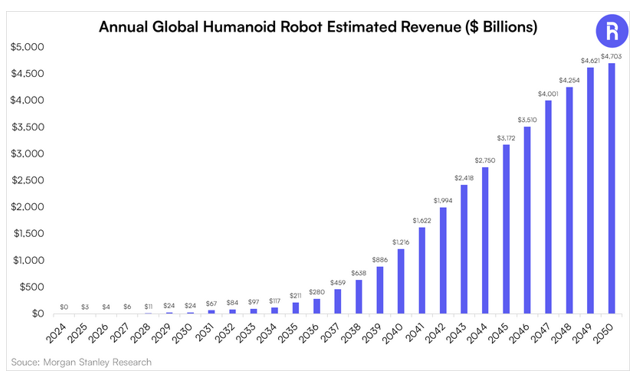
“Morgan Stanley Research estimates the humanoids market is likely to reach $5 trillion by 2050, plus related supply chains as well as repair, maintenance and support. There could be more than 1 billion humanoids in use by 2050,” according to the bank.
It should be noted that while HUMN allocates over 20% of its weight to Tesla (NASDAQ: TSLA) and Nvidia (NASDAQ: NVDA), it’s a global ETF. Domestic stocks account for just a third of the portfolio with China and Japan – robotics leaders in their own rights, combining for 45%. Data confirm the U. S has some work to catch-up with China on the humanoid robotics front, potentially signaling longer-ranging opportunity with HUMN.
“By 2050, about 90% of humanoids, or about 930 million units, will likely be used for repetitive, simple, and structured work—primarily industrial and commercial purposes. China is likely to have the highest number of humanoid robots in use by 2050, at 302. 3 million, trailed by the U. S. at 77. 7 million (up from the previous forecast of 63 million),” adds Morgan Stanley.
Get In On Ground Floor with HUMN
It’s often said that AI is still in its early innings. That’s true and it goes for other compelling theme, such as quantum computing. Humanoid robotics should be part of this conversation. As highlighted in the chart below, courtesy of Roundhill Investments, revenue in this niche is expected to balloon in the years ahead.
Labor crunches and robots’ versatility are among the fundamental factors underpinning HUMN’s potential for patient, tactical investors.
“Warehouse and logistics operators face more than 450,000 vacant roles in the United States alone, pushing hourly wages higher and turnover rates above 40%. Robots‑as‑a‑service contracts priced around $30 per hour for Agility’s Digit are already competitive with human labor. As demographic headwinds intensify, the economic incentive to automate only grows,” observes Roundhill.
Importantly, humanoid robotics are expected to have a Wright’s Law moment, meaning the per unit selling price could be cut in half over the next 25 years as production efficiencies increase. That could be a driving force for adoption and a catalyst for HUMN.