

Oh oh thank you Ozempic and other weight-loss drugs. While no longer new on the market, GLP-1s and other weight-loss are among the driving forces behind a healthcare investing resurgence – one that’s been a long time coming as the sector has been a source of frustration for several years now.
Helped in part by the recent retrenchment in artificial intelligence (AI)—linked stocks, the healthcare sector, which is often viewed through a value lens, is on the mend. Quiet as it’s been kept, the healthcare sector – the fifth-largest sector weight in the S&P 500 -- has been the best-performing sector over the past 90 days while also beating the broader market. Speaking of value…
“Alongside a better-than-expected earnings season, Health Care relative valuations are also attractive, with the sector trading at a next twelve-month (NTM) price/earnings (P/E) ratio of 17. 5x vs. the S&P 500’s 22. 9x,” observes Thomas DiFazio of Roundhill Investments.
GLP-1s Driving Earnings Growth
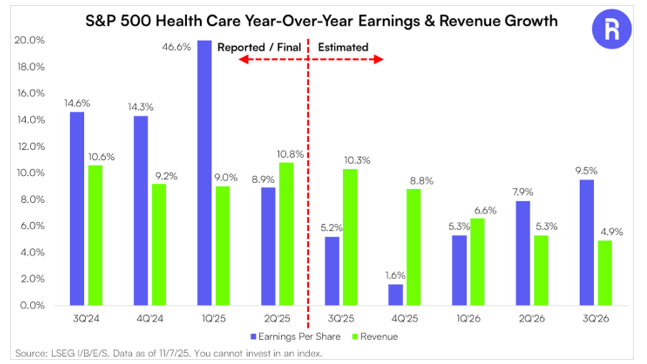
GLP-1s are designed to help patients lose weight, but these pharmaceuticals are helping add heft in just the place investors want to see it: The bottom and bottom lines. With third-quarter earnings season largely in the books, it’s know that 93% of S&P 500 Health Care Index member firms beat earnings forecasts while 84% beat sales estimats.
“At the beginning of the 3Q, S&P 500 Health Care sector was expected to grow earnings 0. 1% year-over-year and revenue 4. 5% year-over-year. Fast forward to today with 95% of the sector having reported, earnings are now expected to grow 5. 1% Y/Y, with revenue slated to grow about 6. 6%,” adds DiFazio.
(Image Courtesy: Roundhill Investments)
Those upside surprises have been helped in part by weight-loss drugs and yes, the ever inventive ETF industry has a way to tap directly into that theme: The Roundhill GLP-1 & Weight Loss ETF (OZEM).
The actively managed OZEM turns two years old next may and allocates nearly a third of its portfolio to Eli Lilly (LLY) and Novo Nordisk (NVO) – the makers of the two most prominent weight-loss drugs.
OZEM Could Be Outstanding
To its credit, OZEM has returned more than 33% year-to-date. Under any circumstance, that’s impressive, but even more so when considering Novo Nordisk, the ETF’s second-largest holding, has tumbled nearly 48%.
That shows the validity of the ETF structure over single-stock bets. Add to that, OZEM is at the right place at the right time because global obesity are expected to surge in the years ahead, indicating the ETF has some merit as a tactical long-term holding.
“Goldman Sachs forecasts that the obesity-treatment market could reach $130 billion by 2030, underscoring the scale of the opportunity ahead,” concludes Roundhill’s DiFazio. “That backdrop is already fueling intense competition among major pharmaceutical players, highlighted most recently by the bidding war for Metsera, clear evidence of how aggressively the industry is positioning for leadership in GLP-1 innovation. ”