


The technology sector is many things – a lot of then positive – but it’s not known for enticing yields. As of Sept. 22, the 30-day SEC yields on the Nasdaq-100 Index (NDX) and the S&P Technology Select Sector Index were 0. 46% and 0. 54%, respectively.
Given that the largest ETFs tracking NDX and the S&P index returned an average of about 117% over the past three years, investors aren’t going to quibble about those paltry yields. Still, to the credit of the technology and communication services sectors, those groups are increasingly valid payout growth stories. Some exchange traded funds make it easy to tap into the theme of rising tech dividends, including the ProShares S&P Technology Dividend Aristocrats ETF (TDV).
TDV, which turns six years old in November, follows the S&P® Technology Dividend Aristocrats® Index. Like the other dividend aristocrats indexes, TDV’s benchmark has a dividend increase streak requirement – in this case an accommodating seven years. In tech, that’s a high bar to clear, but TDV still has approximately 40 equally weighted holdings, including familiar names like Apple (NASDAQ: AAPL), Broadcom (NASDAQ: AVGO) and Microsoft (NASDAQ: MSFT).
TDV Has Plenty of Quality
Advisors and experienced dividend investors know that the key to success with this style of investing is identifying companies with the balance sheets and earnings growth to support current payouts and long-term dividend growth – tasks made easier with TDV.
“Technology stocks have been the market’s growth engine for nearly two decades, and they show no signs of slowing down,” notes ProShares. “According to FactSet, the information technology sector delivered 15% year-over-year revenue growth in Q2 2025—the highest of any S&P 500 sector. Earnings growth was even better at 21. 3%. The sector’s 25. 4% net profit margin was also the highest of any sector. ”
When it comes to having the financial firepower with which to grow dividends over the long-term, TDV checks that box with aplomb because of the S&P 500 member firms with at least $10 billion in cash on hand, nearly 10, including Apple and Microsoft, are TDV holdings.
Speaking of payout growth, since the ETF came to market almost six years ago “TDV has steadily grown its distributions (income) at a compound annual growth rate of 10. 7%,” adds ProShares.
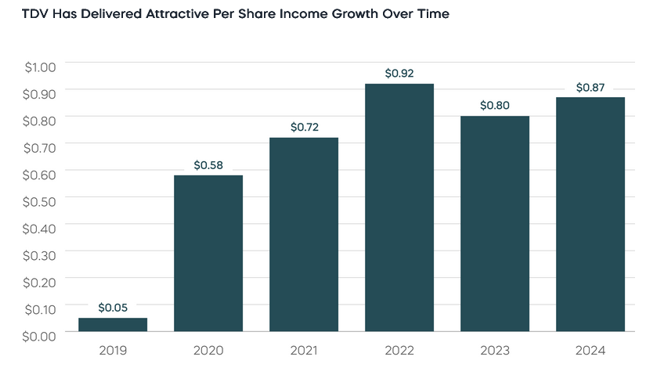
(Image: ProShares)
TDV Tidbits
Some finer points to be acknowledged include the fact nearly 20% of the ETF’s portfolio is allocated to financial services and industrial stocks. In the case of the financial services weight, some of it is attributable to Mastercard (NYSE: MA) and Visa (NYSE: V) – two cash-rich, wide moat dividend stalwarts that reside at the intersection of financial services and technology.
Additionally, newer tech, or in this case, communication services dividend payers such as Alphabet (NASDAQ: GOOG) and Meta Platforms (NASDAQ: META) aren’t eligible for inclusion in TDV’s because they’re not yet on seven-year streaks of higher payouts. It’s going to be awhile before they get there, but at least in the case of Alphabet, there’s some commitment to growing the dividend.
Another point to consider with TDV is that, as noted above, it’s an equal-weight ETF. It brings some diversification and spreading of bets to a sector where it’s hard to accomplish those things in traditional cap-weighted strategies.