

Aspiring market participants and even seasoned investors can come up with myriad reasons to not buy stocks. Those who haven’t yet joined the party may not have the risk tolerance (yet) for it. Some may be saving cash for other reasons while others would rather eliminate debt prior to investing.
Debt elimination and low risk tolerance are valid reasons for not investing in risk assets and the good news is those issues can be temporary and can certainly be conquered. Then there’s old excuse about not buying high-priced stocks, which is not rooted in credibility because a price tag is merely where buyers and sellers meet – not a commentary on intrinsic value.
Speaking of “silly” reasons to not buy stocks, it’s usually experienced investors that come up with those excuses and two of the big ones are perceptions of lofty valuations and a stock or an index being at or near all-time highs.
Alone, valuation isn’t a reason to buy or sell a security, but let’s focus on the issue of buying or not buying when a stock or benchmark is flirting with record highs – a pertinent conversation because that’s the current state of affairs for the Nasdaq-100 Index and the S&P 500.
Highs Invite More Highs
In another life, I was a prop trader and one of my early teachers had an expression “Size at the high meant to fly! ” Essentially the implication there is if a stock is showing strong volume at intraday highs, more highs could be on the way.
Obviously, we’re not all day traders nor should be, but that saying is applicable when it comes to investing when something like the S&P 500 is at or near a record. Indeed, all-time highs, which occur more frequently than some investors realize, invite profit-taking or staying on the sidelines, but some market participants may be surprised to learn what happens when an all-time high arrives: another one often follows.
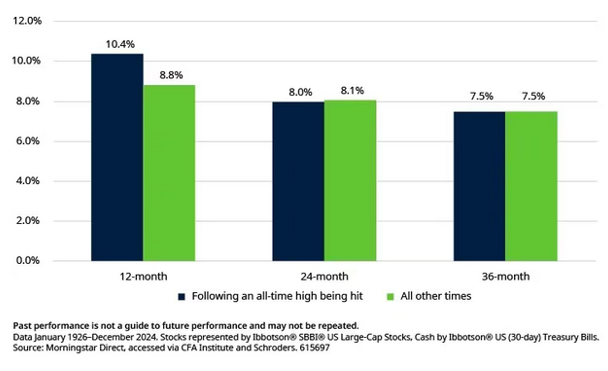
“The market is actually at an all-time high more often than you might think. Of the 1,187 months since January 1926, the market was at an all-time high in 363 of them, 31% of the time,” notes Duncan Lamont, head of strategic research at Schroders. “And, on average, 12-month returns following an all-time high being hit have been better than at other times: 10. 4% ahead of inflation compared with 8. 8% when the market wasn’t at a high. Returns on a two or three-year horizon have been similar regardless of whether the market was at an all-time high or not. ”
Just look at the chart below, courtesy of Schroders, for convincing about all-time highs often giving way to more records.
More Reasons to Stay Invested
No one likes big drawdowns or volatility spikes, but moving to cash or risk-off instruments at the first sign of equity market weakness can be a risky strategy unto itself. After all, market timing is difficult and it’s a skill no one has truly mastered.
In fact, data confirm that remaining invested is a better idea for long-term investors than moving in and out of stocks and that’s supportive of buying at highs rather than fretting.
“$100 invested in the US stock market in January 1926 would be worth $103,294 at the end of 2024 in inflation-adjusted terms, growth of 7. 3% a year,” concludes Lamont. “In contrast, a strategy which switched out of the market and into cash for the next month whenever the market hit an all-time high (and went back in again whenever it wasn’t at one) would only be worth $9,922 (Figure 2). This is 90% lower! The return on this portfolio would have been 4. 8% in inflation-adjusted terms. Over long time horizons, differences in returns can seriously add up. ”