

Even advisors that have client bases largely comprised of baby boomers – a significant percentage of advisors out there – have heard about meme stocks.
A simple definition of a meme stock is one that’s driven almost solely by chatter and speculation and little by underlying fundamentals. With that in mind, it’s not a stretch to say that such stocks have been around nearly as long as financial markets themselves, but the vernacular rose to prominence in 2020-21 when younger retail investors, flush coronavirus “stimi” cash, bid up AMC Entertainment Holdings (NYSE: AMC) and GameStop (NYSE: GME).
Basically, meme stocks are born out of crowdsourcing – a task made significantly easier thanks to the internet. Want to find the next stock or at least some with the potential to reach that status? Forget Barron’s and The Wall Street Journal. Head over to Reddit, X and the AfterHour app. Not an endorsement, but I’ve lurked around AfterHour and can say at least two things. First, not all the stocks being discussed there are fundamentally dubious meme fare. Second, when such stocks are discussed, there are largely credible conversations regarding why the shares could rally over the short-term.
All of that is to say meme stocks, not that they went anywhere, are back in earnest and that’s something for advisors to be mindful when it comes to working with younger clients. Many younger clients are proving to be more financially prudent than expected, but meme stock temptation can be hard to resist and that lead to negative outcomes, such as delaying student debt repayment and saving for a house and retirement.
Price Tags Often Drive Meme Mania
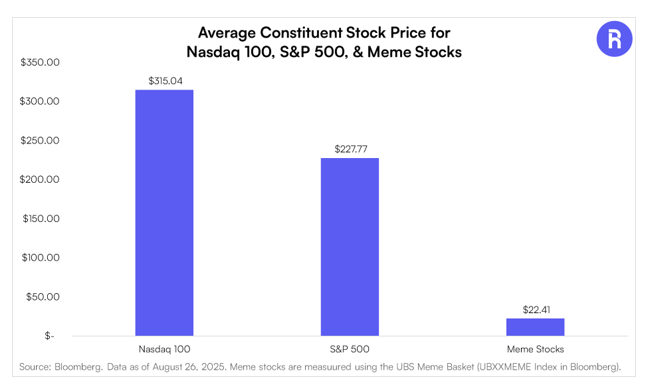
Understanding retail investors’ motivations for getting involved with meme stocks isn’t difficult. One of the primary components is that many meme stocks sport low price tags. Five years ago, GameStop traded around $1. 50. Two of today’s meme names – some say their runs are just getting started – are loanDepot (NYSE: LDI) and Opendoor Technologies (NASDAQ: OPEN). They closed at $3. 51 and $5. 86, respectively, on Sept. 10.
Point is retail investors have always loved low-priced stocks, often ignoring that many stocks arrive at low prices for negative reasons. That affinity is amplified at a time when forward stock splits aren’t as common as they once were, meaning major indexes are littered with stocks with high price tags.
(Image: Roundhill Investments)
“A low share price could be an impactful catalyst for the makings of a meme stock as well. Since the mid-1990s, the average price of an S&P 500 stock has been rising, recently hitting an all-time high of $228 on 8/26/25,” notes Thomas DiFazio of Roundhill Investments.
Not all meme stocks are in the sub-$5 and sub-$10 clubs. Some can and have sported “expensive” price points upon entering the meme club, but the fact is most meme stocks trade below $10 before the meme run starts because retail investors enjoy knowing they can grab a lot of shares without a lot of cash.
Other meme hallmarks include elevated short interest and concentrated ownership, the latter of which pave the way for even marginal increases in volume to prompt gains, forcing shorts to cover.
“When short interest is elevated, rising prices may pressure short sellers to buy back shares to close positions, adding demand to a rally. That buy-to-cover cycle is the basic short squeeze dynamic,” adds DiFazio.
Retail Investors Empowered, Powerful
For much of market history, the potency of retail investors was an afterthought. They bought in odd lots and, later, fractional shares. Their money was appreciated, but seen as having little consequence. Those days are gone. Gamestop proved as much.
As DiFazio observes, much of the meme stock phenomena was born out of Main Street versus Wall Street, us versus them lines of thinking. That’s ebbed, but what hasn’t waned is the ability of a group of well-organized retail investors to move a low-priced stock.
“Retail participation has become a structural feature of equity markets. Zero-commission trading, fractional shares, mobile access, and a constant flow of real-time information lowered barriers and made investing communal,” concludes DiFazio. “Ideas travel faster; communities coalesce overnight. That backdrop helps explain why meme-style bursts recur in waves rather than disappearing entirely. ”
Advisors would do well to remind meme-enthused clients that not all meme stocks turn into Gamestop situations and that if they must enter the meme casino, it’s best to do so for small stakes.