

There’s an array of admittedly interesting research out there confirming that if investors were to depart stocks a day, two or a few days prior to the S&P 500’s worst days of a given year and get back into the game shortly before the index’s best days, their returns would be exponentially better.
It’s probably accurate, but also risky advice to follow for a simple reason: No can see the future. The aforementioned practice also amounts to market timing, which is arguably one of the most difficult if not foolhardy endeavors an investor can engage in.
Devout market timers often neglect to mention the tax implications of frequent selling of profitable positions and that wash rules don’t apply if investors are moving in and out of the same products in essence of market timing. Likewise, they don’t extol the virtues of riding out bear markets for the purposes of potentially finding value or adding to existing positions at better pricing.
The point is time in the market, not market timing, is what’s truly valuable and that’s not opinion. It’s an assertion rooted in data.
Staying Invested Matters
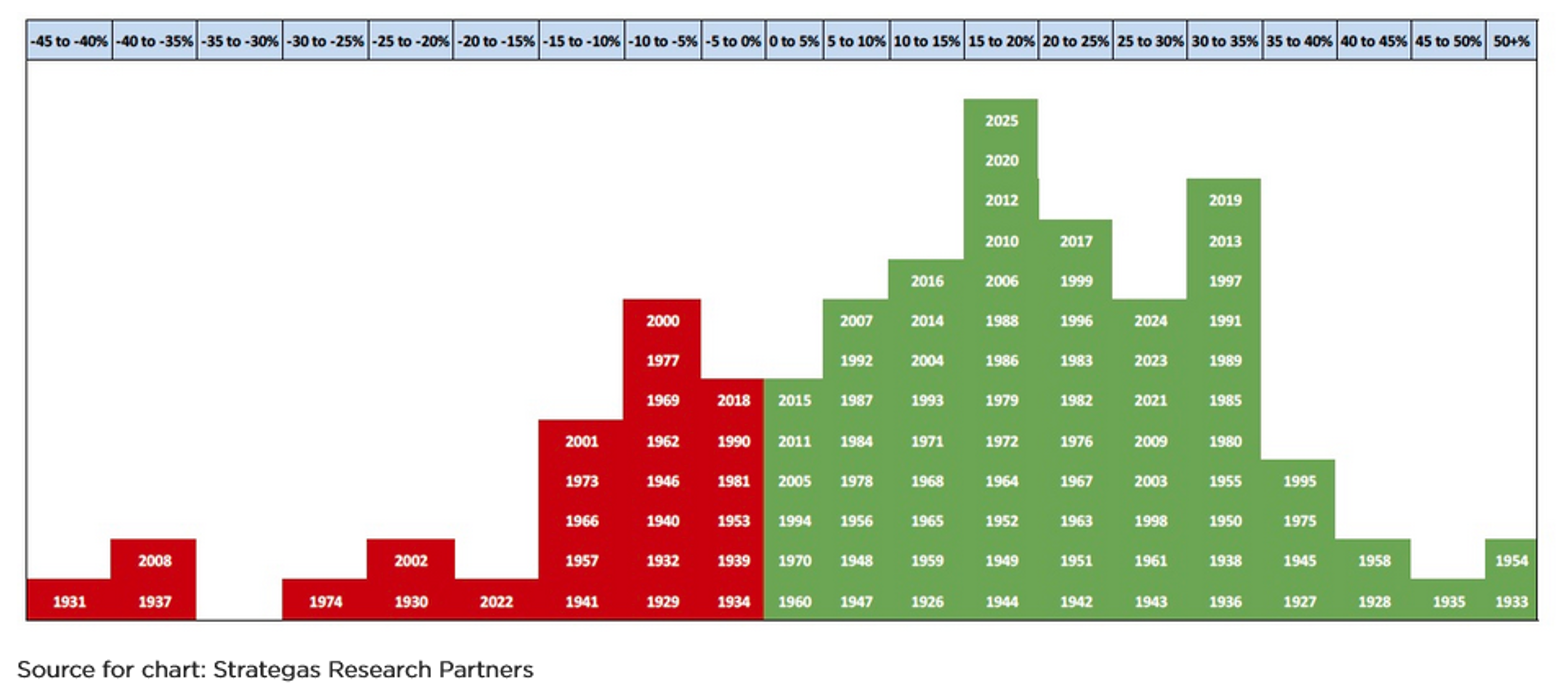
Financial markets aren’t always “perfect” and stock rarely meet all investors’ demands, but history confirms equities steadily grind higher over the long-term and are among the most important wealth creators readily accessible to everyone. On a related note, it must be acknowledged that the best (and worst) years of market performance tend to arrive in tight-knit groupings, saying something like four excellent years in five and so on.
“Looking at calendar-year returns for the S&P 500 since 1928; one thing stands out: the market rarely delivers an ‘average’ year—defined since 1950 as roughly a 10% return,” notes Mark Hackett of Nationwide. “Instead, returns tend to cluster at the extremes. About three out of four years have been positive, and many of those gains exceed the long-term average, often landing closer to 20%. Down years are less frequent and generally smaller in magnitude, with losses averaging closer to 13%. ”
(Chart Courtesy: Nationwide)
As the chart above confirms, stocks perform well more often than not. In some regards, investing is the exact opposite of gambling. In betting, be it sports or walking into casino, the odds are against the participant, but in investing, the odds are on investors’ sides.
“This imbalance is the quiet engine behind long-term returns. Think of it like a weighted coin toss: ‘heads’ delivers a 20% gain, while ‘tails’ results in a 13% loss—and heads comes up roughly seven times out of ten,” adds Hackett. “No single flip reflects an ‘average’ outcome, yet over many consecutive flips, the math compounds in investors' favor. ”
Don’t Mess With a Good Thing
Of course there are times when investors should cut losers because not all securities rebound. It’s always better to prevent a temporary mistake from morphing into a larger, permanent loss. And for investors that like to be more active, there’s nothing wrong with that and no one is saying “set and forget” is appropriate for everyone. However, market timing isn’t for everyone. It’s arguably for no one.
“The next step for investors is straightforward—but essential: stay invested,” concludes Hackett. “Time in the market, not timing the market, remains one of the most reliable drivers of long-term outcomes. The longer clients can maintain a diversified portfolio aligned with their objectives, the more the market's natural asymmetry works in their favor. ”